

2025 recap
10 lessons learned from the year

Investing is composed of a myriad of emotions. This is par for the journey, but also provides exhilaration as the tidbits slowly form together as the knowledge and experience build together. This is the essence of compounding….slow, slow, slow, then suddenly the picture comes together as all of the hard work pays off. Below are ten lessons I have learned just in the past year alone as the snowball of knowledge in my investing journey continues to slowly build. Nothing quite beats personal experience so here is mine to share as I hope to become a much better investor each and every year I pursue this wild journey. Caveat to all I say below is a reflection based off of my personal investing strategy.
***See Points #8 & #9 for the specific stocks mentioned as successes and errors.
#1 - FOMO buying in a downtrend; anchoring bias.
My most important lesson overall was to to be slower to act and not rush. I have fallen into a common trap of new investors in that inertia in the markets is a powerful and violent force. Averaging down into losing stocks is a natural behavioral bias that I have fallen victim to. While at times I have reevaluated the stocks and determined that the fundamentals do remain strong, if I am being honest with myself the market is clearly discounting the news much more heavily and oftentimes will continue to punish the stock, albeit to an unfair degree at times.
I am not a technical analysis investor by any stretch, but the one takeaway I could probably agree with is that stocks that are above their 200 day moving average will typically go up more than stocks that are below their 200 day moving average. Momentum and sentiment command the short term price and the market is currently as shortsighted as ever. I am looking for contrarian and asymmetric opportunities, but I also want to respect the market’s playing field and acknowledge these opportunities arise far less likely than it seems. While not aiming for perfection, timing these bets can often be rewarded with higher patience and careful monitoring. Raising the hurdle rate of what makes it into my portfolio and also when it does. Losses and drawdowns are all part of the game, so I am not saying to avoid these altogether, but I do believe there is a way to more reasonably manage risk and your inevitable losing stocks by giving your winners a higher % of your allocation rather than averaging down, which is what I have been prone to do thus far (easier said than done). See Point #8 for my specific mistakes as evidence.
The change: From “The Art of Execution” by Lee Freeman-Shor - Future Strategy: Be an Assassin: Sell a losing stock quicker at a predetermined loss percentage (let’s say -20%). Focus on preserving capital and concentrating into best ideas. This prevents small losses from becoming catastrophic ones. Assassins use strict rules (e.g., a trailing stop loss or selling if no recovery within six months) to remove emotion from decision-making. Watering flowers, cutting weeds.
#2 - Concentrating into best ideas; can the stock double in 2-3 years?
The key: Know those companies inside and out (especially microcaps). One common element of my mistakes would be this: overly aggressive assumptions. Now obviously you do not know these assumptions are overly aggressive in the moment, but typically you have an idea and one way to minimize these mistakes is by having an initial higher margin of safety. This naturally results with an investor concentrating into their best ideas (see Point #1). I want to err on the side of conservative growth assumptions rather than relaxing and stretching my own DCF model to make the investment case fit into my box.
One question that presents a quick filter is just by asking at the very start on if I believe this investment can double within 3 years (exceeding my own hurdle rate)? Not every holding is going to meet this criteria, but for new investments this has proven to be helpful. If possible, this normally means that I feel the current value is both extremely undervalued and while obviously I cannot time the market; I do believe there is a higher possibility of a near term positive catalyst, i.e., earnings inflection, margin improvement, specific fear to pass, sentiment to flip, short term execution, etc. I do not mean this point as in looking for riskier business models with higher upside and downside, but rather looking at a stock that is temporarily depressed or clearly misunderstood. Lower risk, higher reward. My personal investing goal is to strive for 15% CAGR, so by looking for opportunities that could potentially eclipse that mark gives my portfolio a “margin of safety within my margin of safety” with my individual holdings, which as experience points out is often very much needed as various outcomes play out in unpredictable fashions.
#3 - Doing less, making less decisions
Investing is a very unique pursuit as it is one of the only activities that you do not necessarily become better at by practicing more often and just doing more activity in general. You need the ability think clearly and deeply, and the associated behavior that is willing to act independently of rabid groupthink. You do not need to constantly be executing trades left and right, far from it. Costs and taxes can quickly add up and while I do love investing, I have found myself prone, like many others before me, to overactivity. Constantly checking prices, portfolios, and making trades weekly or even daily is going to eat into your returns. You do need to put in the work, but once that is completed, remain actively patient, then you will be ready to identify and strike when the opportunity presents itself, which more often that not it will.
As Buffett famously said, this is a no called strikes business for us retail investors. That is an amazing advantage that we do not have to constantly be posting new ideas, turning over our portfolios, adding/selling/trimming, etc. These are all weapons at our disposal, but for the vast majority of our time we can sit and think, and be patient as we ignore the noise and focus on the key criteria that will determine our portfolio’s success or failure. I admit that I am a man, and my first inclination is to fix something (even though I am a terrible handyman), but when it comes to long term investing, less tinkering is certainly more. I am only operating my limited pool of capital, so I do not need to strike often, but more so need to maximize my bets when they are placed.
Decision Leverage: The goal is to make a small number of correct decisions that will pay off for a long time. Partnering with exception management whom you trust is a sound way to do this. Ignore ‘Top stocks of 2026 lists’ and constant stock pitches, but rather dig deeper into what I already know.
#4 - Active patience + watchlist companies
As mentioned above, investing really is not about doing more, quite the contrary as overaction statistically harms the portfolio’s performance. So just what can be done then? #1 - Monitor my existing holdings. There is an investing bias I observe where investors become less enamored with their existing holdings and tend to spend all of their time and energy searching for new ideas, or “turning over rocks.” This is great and all to a degree, but where the bulk of our effort should be spent should be monitoring the key performance indicators of where your money has already been put to date. Oftentimes, the next incremental $ spent should be on adding to a business already in our portfolio that is executing incredibly well and your thesis is playing out.
With that being said, investing is the pursuit of continuous learning and companies get added to the watchlist as they become potential investments. That watchlist can then get ranked or categorized, and then as valuation potentially moves to more attractive levels, then I say do not be afraid to act upon your research and work. Prices and sentiment can shift gradually, then very suddenly. An important job of an investor is to know the companies you follow in detail including your estimate of valuation and be ready to strike if it meets all of your criteria. When this criteria is fully met, have the necessary courage to act upon your conviction. If you do not, then what is the point?
An example of this for me this year is Constellation Software. I have always admired and followed the business, but did not get in early enough in my journey and the stock had never had a drawdown over 25% until this year (low at 37.4%).
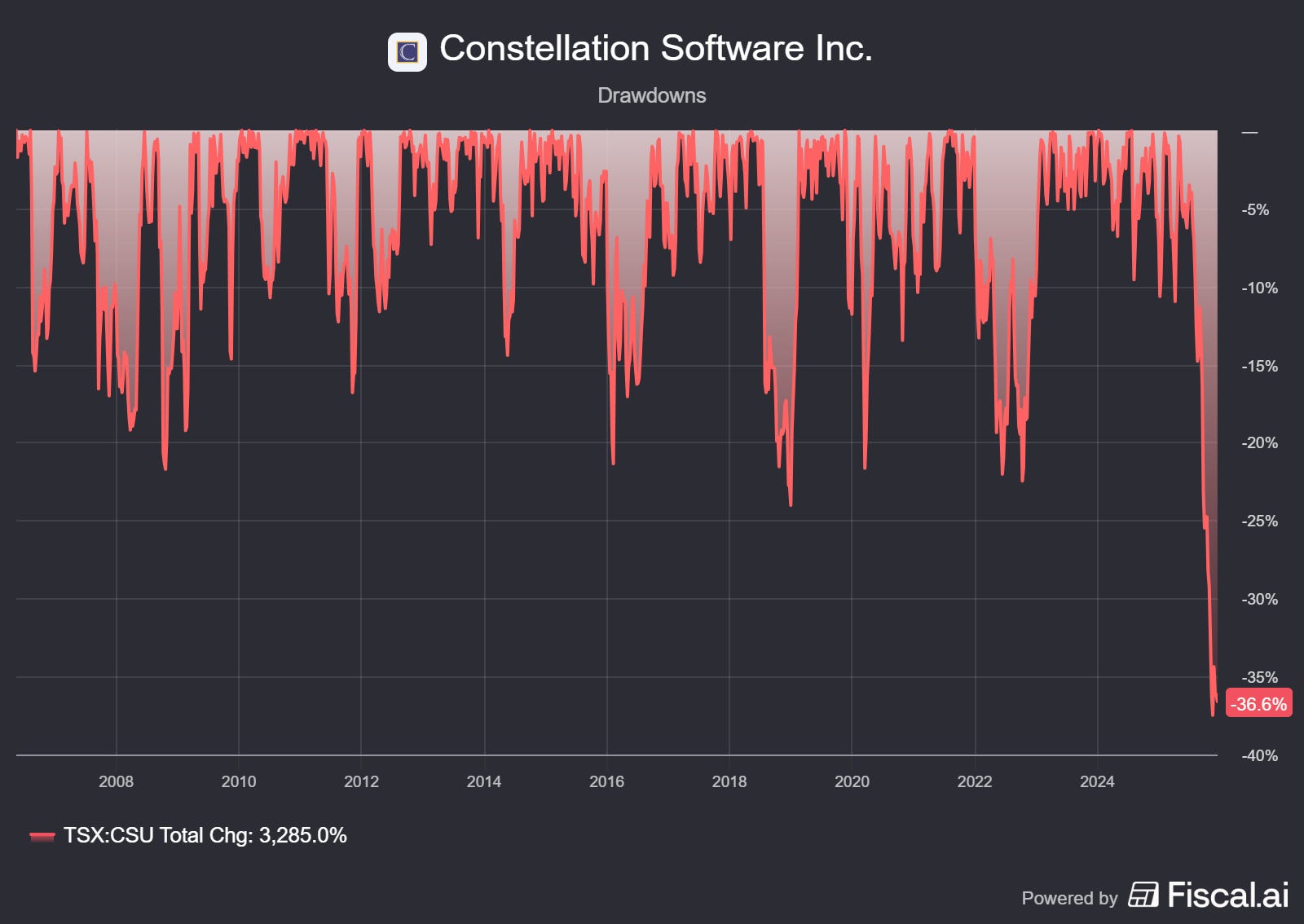
My quick take is this is largely driven by 3 factors: 1) AI fear is going to kill off CSU’s portfolio of VMS (vertical market software companies), 2) Sudden retirement of CEO/Director Mark Leonard (due to health reasons), and 3) There was simply a large investor base who owned this solely due to the fact that the stock had never had large drawdowns until now. My own analysis largely dismisses these risks and I have weighed the current risk/reward as favorable and heavily added the name into my own portfolio (perhaps overly hastily). Amidst the fear of disruption from AI, the business is executing as strongly as ever and has a great core team of the strongest capital allocators. Although the stock continued to do poorly this year, I believe looking 5 years down the road, this year will be looked at as a great buying opportunity albeit with slightly decreasing incremental returns.
#5 - Trading around high beta growth stock names
I am not just a “value” or “growth” investor as typically I enjoy a combination of both which I label simply as investing. However, I do have to acknowledge that certain higher growth names will have a lot more volatility implied with the stock prices. Take a look at some of these names I follow/hold.
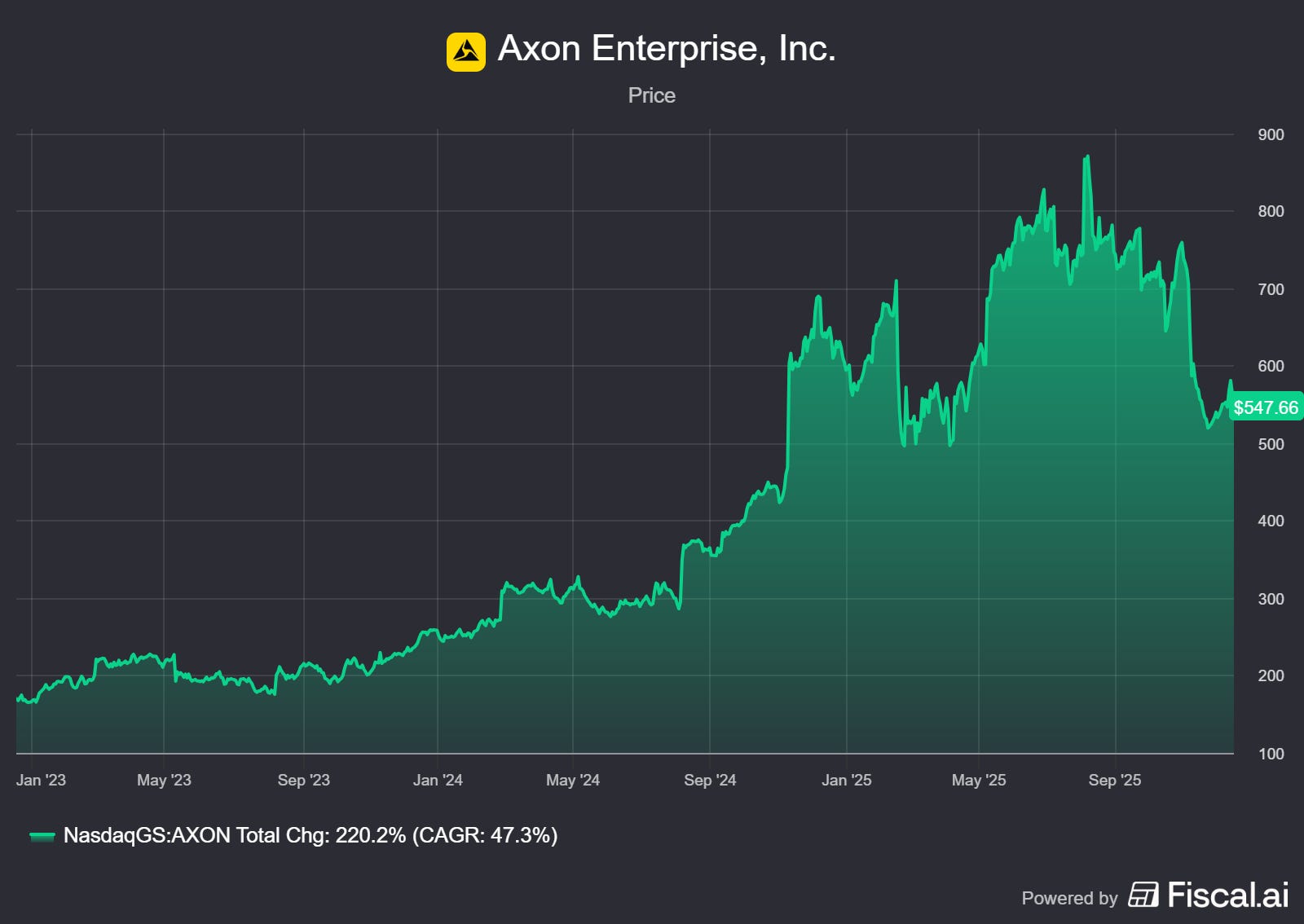
Axon rose from ~$400 in Nov ‘24 to $871 in Aug ‘25 (over 100% in < 1 year) and now back down to $~500 in Dec ‘25 (40% drawdown in 3 months). Wow, what a ride!
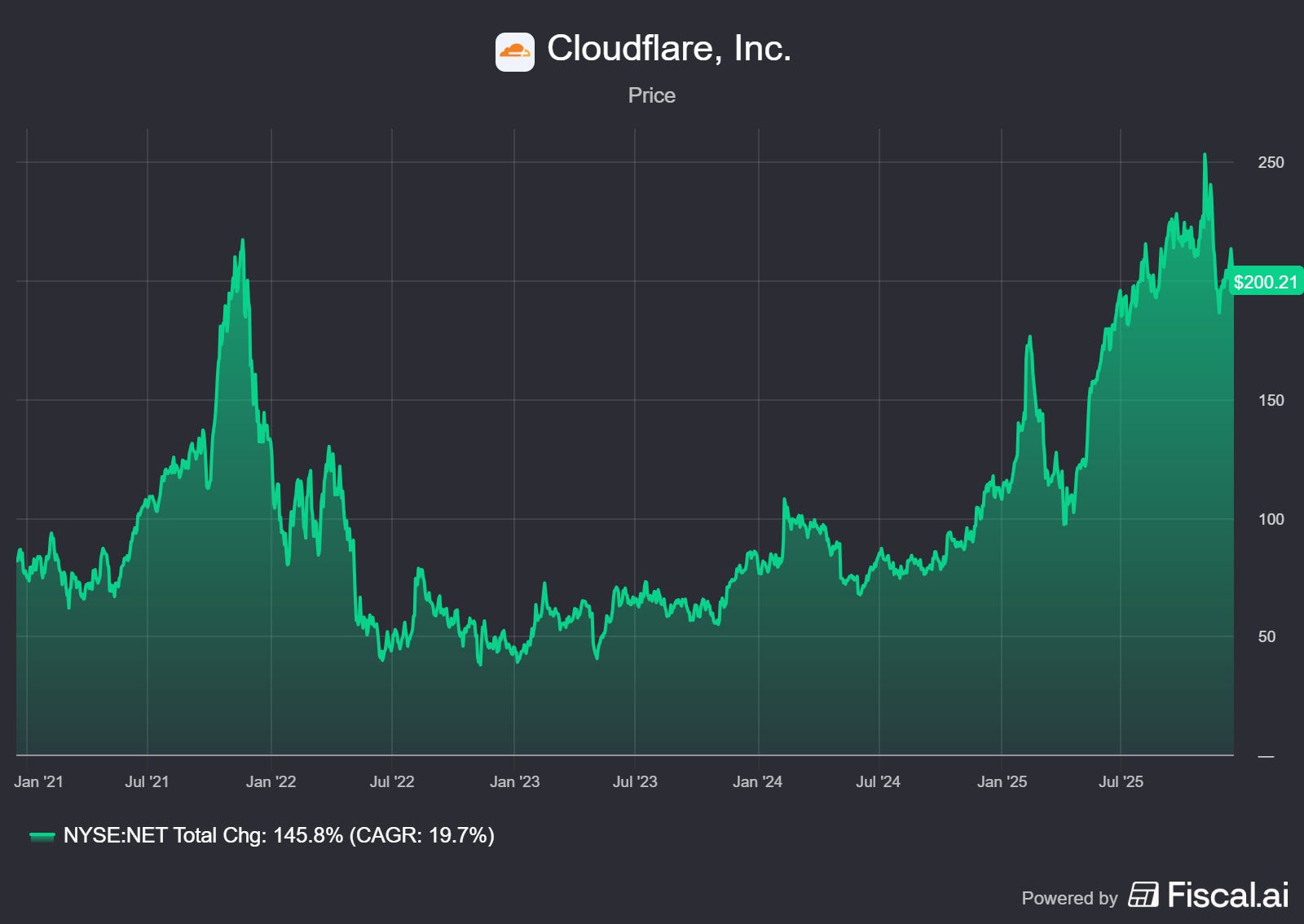
From $60 in Mar ‘21 to $217 in Nov ‘21 to $40 in June ‘22 to >$250 in Oct ‘25. At points in there it clearly has been overvalued and at other points it has clearly been undervalued. Axon and Cloudflare are just two examples, and these are large-cap, well-known companies. Obviously, Tesla and Nvidia are their own volatile beasts, but there are numerous other examples every single year where growthier names trade around extreme ranges as the slightest twitch in sentiment or news can drastically swing the price one way or the other. A laser focus on the fundamentals of the business should bolster an investor’s confidence of when to rationally take money off or put money on the table.
You can never times the lows and highs perfectly, but those are drastic ranges that can be used as tools to your advantage. The market can be a manic depressive or an irrational optimist, and I want to operate in the rational middle as much as possible. When the risk/reward becomes either highly favorable or unfavorable, then I retain the flexibility to take advantage of these outcomes. A core belief is to let your winners ride, but I am more convinced that within that ride, there are opportunities to, at the very least, slightly level the overall risk/reward playing field by trimming certain holdings that will allow you to redeploy your capital at more favorable times. The market swings are occurring as quickly as ever nowadays and I want every weapon at my disposal to adapt to this phenomenon. I am not looking at this as main piece of my strategy, but looking at my portfolio on a monthly basis and just seeing which stocks have either extreme optimism or extreme pessimism baked into the valuation and tweaking my allocations accordingly for more favorable probabilistic outcomes.
#6 - GARP - Define growth? Define reasonable price?
This point rhymes with Point #2, but a real key takeaway is learning to be highly conservative with implied assumptions and also determined to invest with a higher margin of safety. This does not always mean investing in the highest quality company, but a company that I thoroughly understand and with a highly favorable risk/reward probabilistic outcome. Typically, this approach should force me to more quickly pass on “almost all” stocks and also force me to be more patient on repurchases or entry points. I see a lot of investors say they are “GARP” (Growth at a reasonable price), but even this can be a very loaded statement. It all comes back to what is being implied in today’s valuation? 10% growth might not seem like a lot, but if there is so much negative sentiment baked in, then 10% growth might be all the stock needs to really succeed. A durable 10% growth over decades is still incredibly stable growth as it is vastly outpacing GDP. I always see a lot of chatter and the focus on “rapid high growth” who can post >30% growth a for a few quarters, i.e., a recent IPO. Big whoop :) These models are often incredibly fragile and are being run for the insiders to profit from and not for long term shareholders focused on sustainable growth. I am interested in the stocks that can reasonably grow earnings 15% for decades; very rare. Some stocks get so overheated, that even when the numbers knock it out of the park, the stock can eventually begin to retract as there are impossible expectations being baked in. Some recent examples that come to mind: Palantir, Nvidia, Axon, etc.
Is there a higher chance that the multiple expands or contracts? Earnings slowing down and multiple contraction will be a major hindrance on your return. Swing the growth and price both in your favor by raising your investment hurdle and margin of safety. Find the best risk adjusted returns that are either out of favor or have momentum against them. Not just stocks that look cheap from a valuation perspective, but actually find specific catalysts, contrarian evidence, allow bottoms to materialize and price consolidation, etc. Hopefully, you have diversification in your portfolio so that not everything is going up or down at the same time giving you the mental fortitude to always stay invested. The quality of a company will be much more important than its current valuation over a long period of time, but do not overestimate the strength of a company’s business model over time.
#7 - Independent thinking is key.
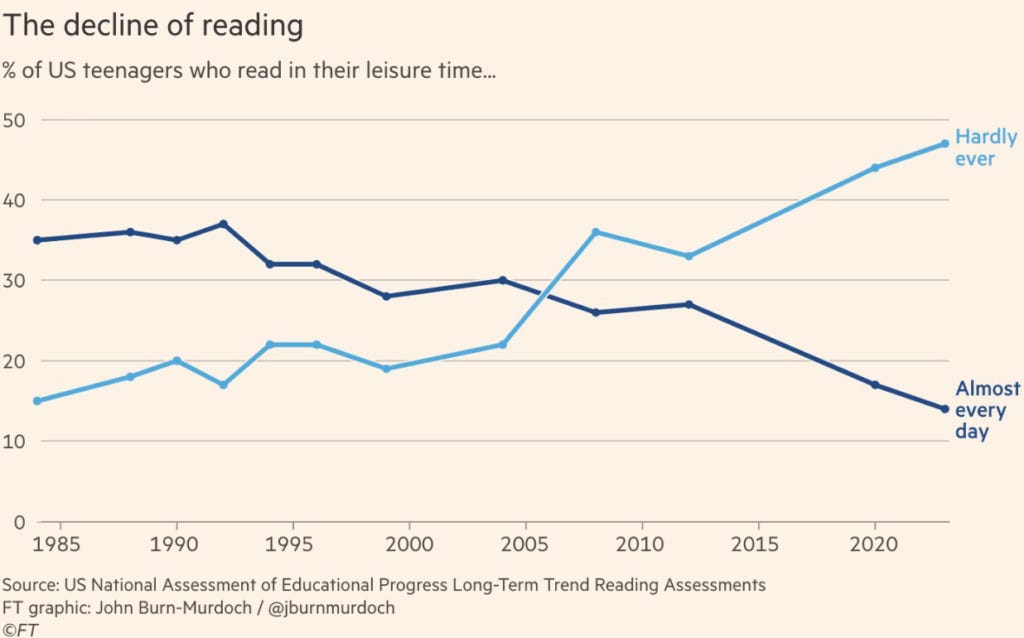
Sentiment follows price, so you will do the same if you are not thinking deeply and independently. With the rapid advancement of AI and LLMs, technology and information is moving faster and faster than ever, however, the measure of deep thinking seems to be declining from my anecdotal evidence. You see a lot of strong opinions, loosely held and not backed up with actual data and evidence, which you can apply that to whatever subject in question, but especially investing. Just take a look at the the decline in reading rates amongst the youth.
Obviously, there are many ways to generate wealth, but in my view the key to investing is to develop a systematic approach that shifts the probabilistic nature of the future into your advantage. Ways to do this our first and foremost: 1) expand your time horizon past the next quarter and year, which is the where Wall Street is looking. 2) You must have some differentiated view over a company’s current valuation. This can come from many different places from your analysis such as, durability of a company’s moat is much stronger, earnings are temporarily depressed, unit economics are misunderstood while margins inflect, etc. These different conclusions can only be arrived at correctly through an independent mindset that involves critical thinking skills on full display. An investor cannot simply follow the herd now and say they are bullish on AI as that ship has long sailed. Investing with the herd feels safe, but will often lead you to getting in late and open yourself up to the biggest valuation correction which can hurt.
There are many different goals, personalities, and strategies available out there. Do not get drowned out in the noise, but discover who you are as a person that aligns with who you are as an investor and your ultimate goals. That may sound very Buddha monkish, but investing ultimately comes down to 1) knowing your goals, 2) defining your process, 3) refining your behavior, 4) ability to evolve 5) patience to outperform. Most of these aspects need to be anchored in thinking for yourself and deeply processing information. Money is a tool, not the ultimate goal.
Adjustment: I plan to do more case studies to deeply learn from investing history that can be applied to the present: Dirtcheapstocks, John Huber, Joe Kelly, etc.
#8 - Mistakes, yeah I made a few…
Everyone makes mistakes, the question is how much do we learn from them.
$CMG.TO - Oof, well a few painful lessons learned from this one. #1) The business quality was not nearly as high as I thought it was. I could go into more detail on this and while I am far from an expert in this field, I should have done deeper research to more fully understand the dynamic landscape. The main issue is that this software is still heavily tied to the O & G industry (oil/gas) it operates in a more cyclical field than I ever presumed (not as highly recurring as other SaaS). #2) I overly relied on cloning this idea from investor Chris Mayer and sized up this position far too quickly despite the negative momentum that had built up. You can never borrow conviction, it needs to come from deep within. 3) Turnarounds seldom turn. I am more and more coming to this conclusion that Buffett himself came to many years ago. While not impossible, turnarounds seem more and more improbable in my experience. $CMG.TO has a lot of moving parts and was undergoing a transformation, and while I believe it is the right long term approach and put the right people in place, the story can still take a long time to play out. I sized up this position in too much of a hurry, rather than stepping back and digging into the company’s competitive advantages and what the market was trying to tell me. See Point #1 at beginning.
$EVO.ST - This business has not lacked storylines. A business that I follow very closely that has had its growth come to a screeching halt.
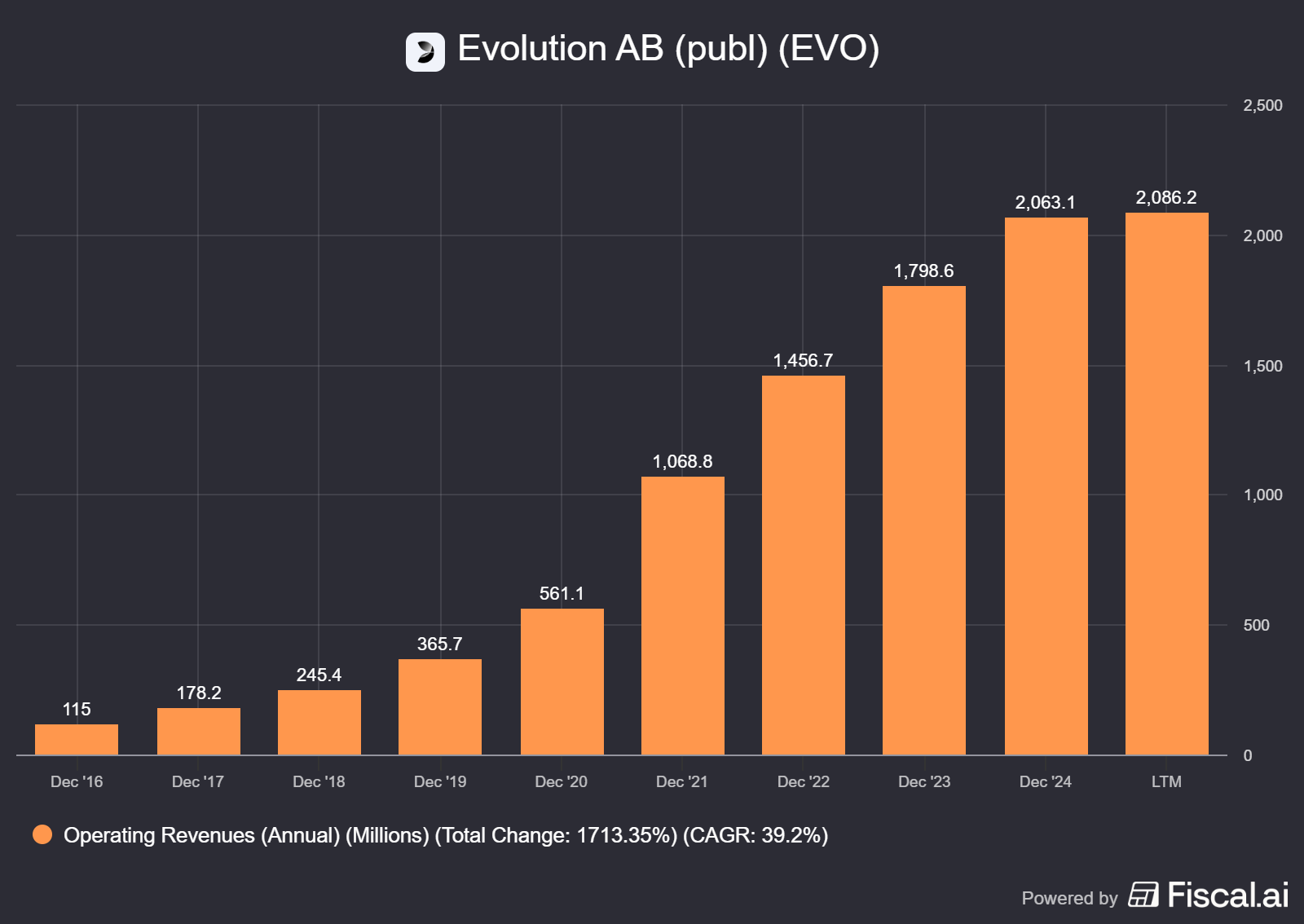
Revenue was growing at 90% in 2021 and now at 4% in 2025, while decreasing sequentially QoQ. That is going to have some serious multiple compression attached to it, which is exactly what we have seen. I have unfortunately added all the way down as I still believe the core biz is strongly positioned and makes the best online games by far. A painful personal lesson. The business has run into the perfect storm and management has not exactly come away scathing clean. What is the lesson: Many, but similar to $CMG.TO above, this is a business that is more or less tied to the industry it operates in. In this case, the online gambling is extremely opaque with some markets being regulated (good and bad) and others being unregulated. This makes regulation a huge risk as unregulated markets invite numerous nefarious characters to the table, while regu
lated markets (if done poorly) can place a heavy burden on growth. Evolution has quickly gone from a growth story to a turnaround one, and as I previously mentioned I hate turnarounds. Once there is negative momentum, do not just immediately presume a better valuation, but look under the hood and try to fully grasp at the factors that are causing the negative pressure and their severity. For Evolution, I viewed these threats as passing, and they still might be, but they were far more systemic than I initially analyzed. Another key lesson, valuation does not matter until it does. I do not think anyone thought growth would halt as drastically as it did, but with that being said, always bear in mind your initial margin of safety and what are the historical multiples for related businesses. Valuation is akin to gravity and multiples always have a way of always bringing you back to earth eventually.
$MATR.TO - This was another business in the midst of a transformation, where boiling it down, you had management trying to do too many things rather than having a sharp, singular focus. Mattr Corp’s transformation, which included a rebrand from its former name ShawCor Ltd., involved a strategic shift from being a company heavily reliant on the cyclical oil and gas pipeline services market to a focused materials technology company serving broader, more resilient critical infrastructure markets. In short, the company was seeking to lower its exposure to O & G and focus on higher growth areas, which in my mind is once again the right long term strategy, but add in the whole tariff drama, and this just added up into a bit of a more messy story that management had a hard time articulating. My lesson is to distinguish what Wall Street is perceiving to can management execute and sell their story to the investing community. I do not want to wait around 5 years for the chance that the story may eventually play out.
My takeaway, unless you can see light at the end of the tunnel, then investing in a business undergoing a large strategic shift likely will be too high of a hurdle. There are so many options in investing, look for the ones with higher margin of safety (see Point #2 above), aka the 1-foot bars. Now, I had a very successful investment play out in Secure Waste Services $SES.TO that also had a bit of a transformation story play out, however, the key difference I would say is $SES.TO is highly cash flow generative and was therefore able to buy back a ton of shares (which put a nice floor on the price) as where Matr Corp carried way more debt on the books.
“I don’t look to jump over 7-foot bars: I look around for 1-foot bars that I can step over.“ - Warren Buffett
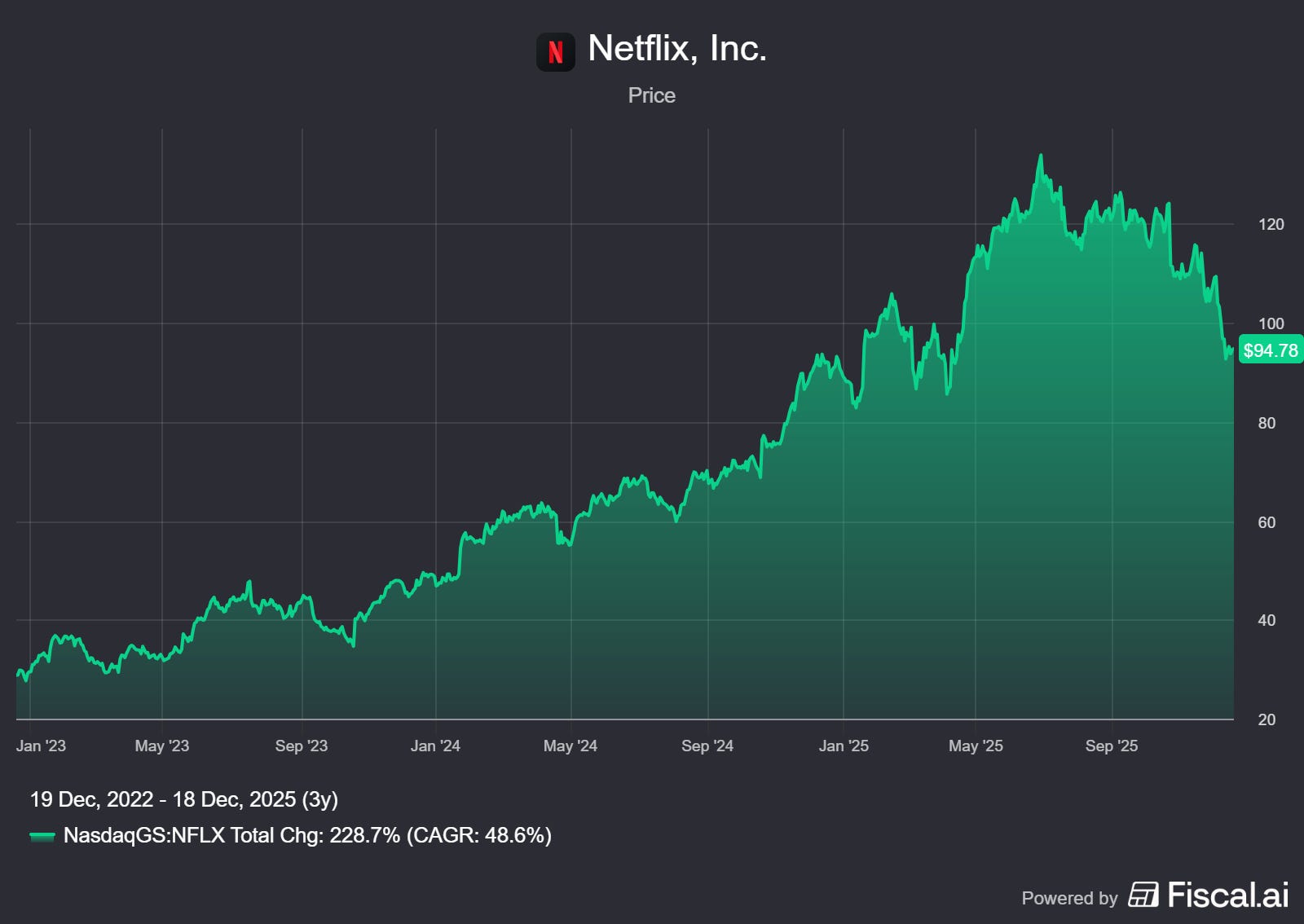
Netflix NFLX 0.00%↑ - You do not only want to look at errors of commission, but also errors of omission as well. I have a few on this list, but a glaring one to me is the missed Netflix trade. I love this hunting ground of “fallen angels” or “broken compounders” where the underlying fundamentals tell a very different story. The streaming environment has undergone massive competition, but Netflix had a mile long head start while being so entrenched in the consumer’s mind, including my own. Growth in the US market only slightly slowed, but they are still heavily growing in all other areas of the world while strategically branching out into other other live segments. They won the streaming wars and it was not even particularly close. The stock had a drawdown of 75.9%, which was completely unjustified. You never know what the bottom of the stock is going to be or when the stock is going to correct, but this was clearly not a broken business and one that I knew unlike so many others. The stock pulled back recently due to the massive Warner Brothers acquisition, but was casually up 364% in the past 3 years prior to that. This was a consumer product that I was obviously familiar with and should have invested in during peak fear sentiment if not for a short term trade.
#9 - Successes
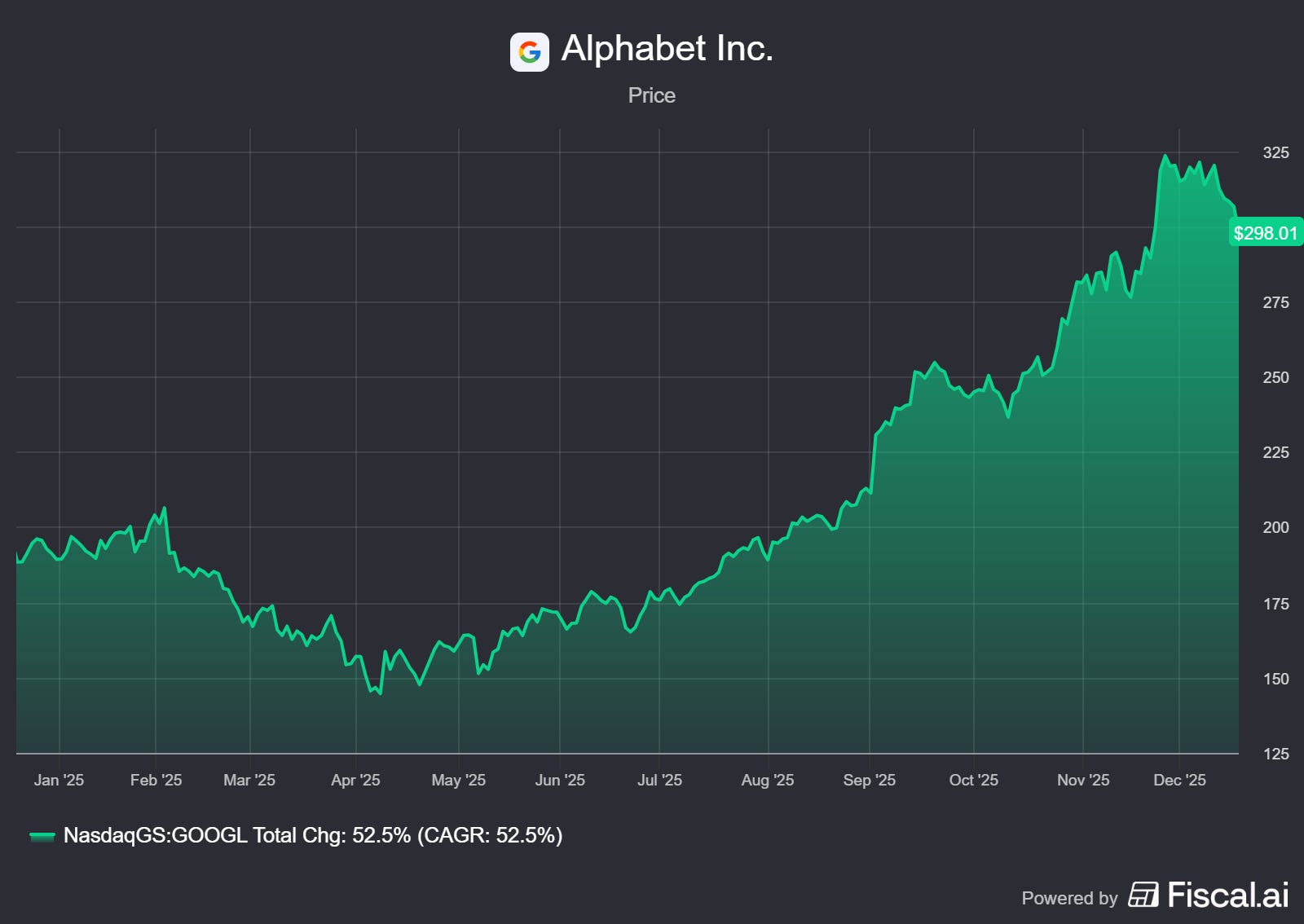
Google GOOG 0.00%↑ - Google, I have held this stock for awhile and really did not ever strongly consider selling. While I did view ChatGPT as a very valid threat to Google’s search moat, Google itself is an incredibly well diversified business with many other segments growing strongly and a Fort Knox balance sheet. My sense was that if anyone could figure out the deployment and monetization of AI, it would be Google, because this new technology was adjacent to what they had already spent decades doing plus they have the resources to deploy where needed. I had no idea that sentiment would flip 180 degrees so quickly (markets still amaze me), I just knew that the price action was largely built off of negative sentiment, rather than fundamentals, and that was not a justification for me to sell. Much has been said about Google, but it still blows my mind that one of the largest and most well known companies in the world can have a stock chart that looks like the below, up over 100% from the April ‘25 lows.
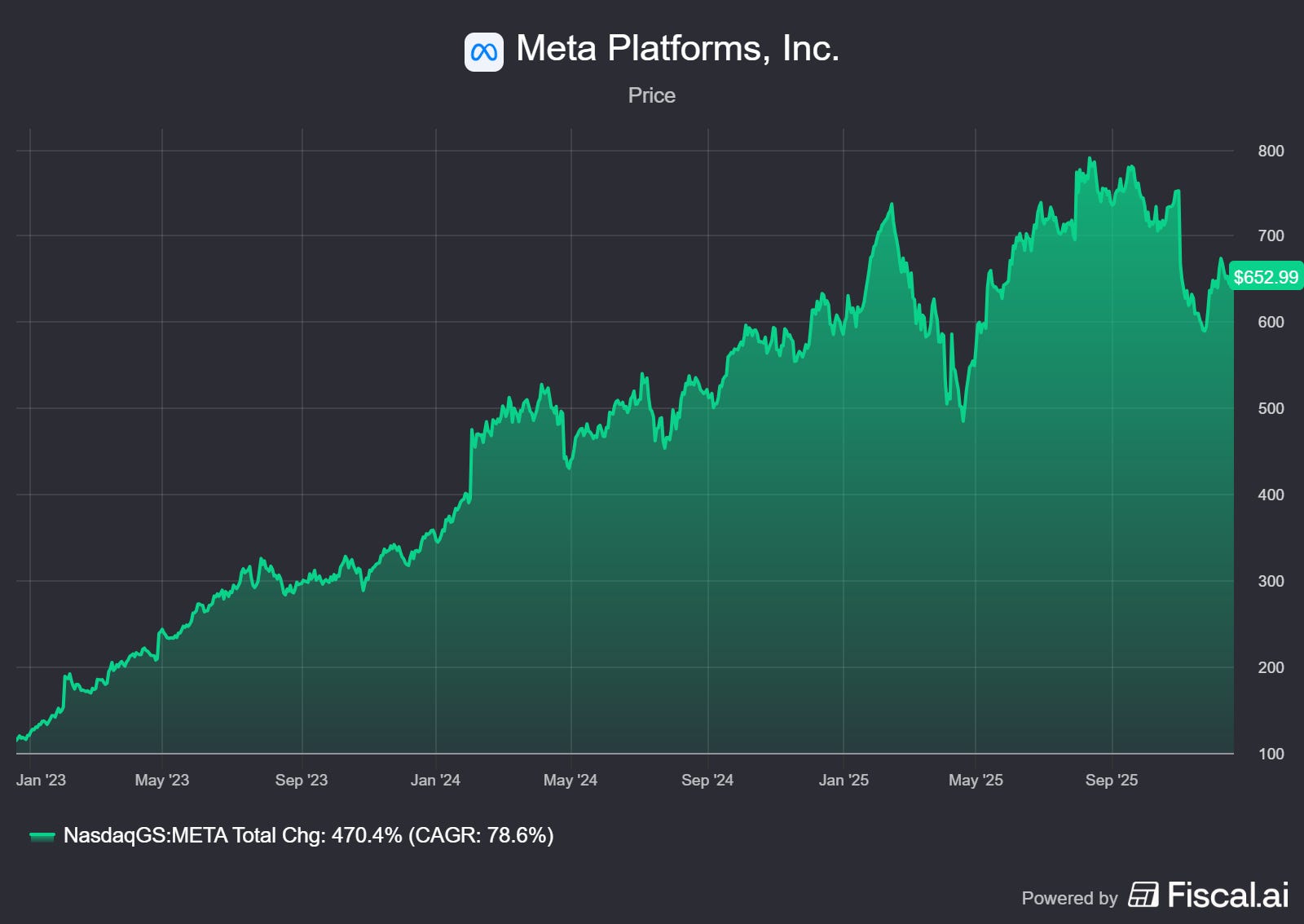
Meta META 0.00%↑ - I have conflicting emotions about Meta. The price bottomed in November 2022 at $87.48 and Mark Zuckerberg’s famous “year of efficiency” brought the stock roaring back in 2023 now through 2025. Meta’s stock is up >700% from 2022 lows. This illustrates just how powerful sentiment can be. It may seem silly now as I hear all the time investors say “how they should have invested in Meta”, but I can vividly remember just how scary and terrifying this idea seemed to be at the time. There were legitimate fears/concerns: advertising slowdown, Metaverse money pit, rising costs, TikTok competition, Apple’s IDFA changes, etc. It seemed that just about nothing was going right and that growth had 'matured.’ While I am definitely not a fan of all things Meta and my conviction definitely wavered, the lesson I keep coming back to is this: Sentiment swings overly wild in both directions (optimistic and pessimistic). Meta had every negative headline/momentum, but it was far from a dying business and its daily active user count was continually increasing. Zuck practically invented the online ad game and is one of the greatest founders of all time albeit hugely controversial. Sometimes, you do not need be a genius or make a radical call on a company, you just need to remain rationally calm and hold the stock through turbulence. This is why emotional intelligence is so often underrated. I had no clue what Meta’s stock was going to do, I just knew that Meta was still one of the most relevant businesses in the world with a ginormous network effect and that I did not want to sell at peak pessimism. The end.
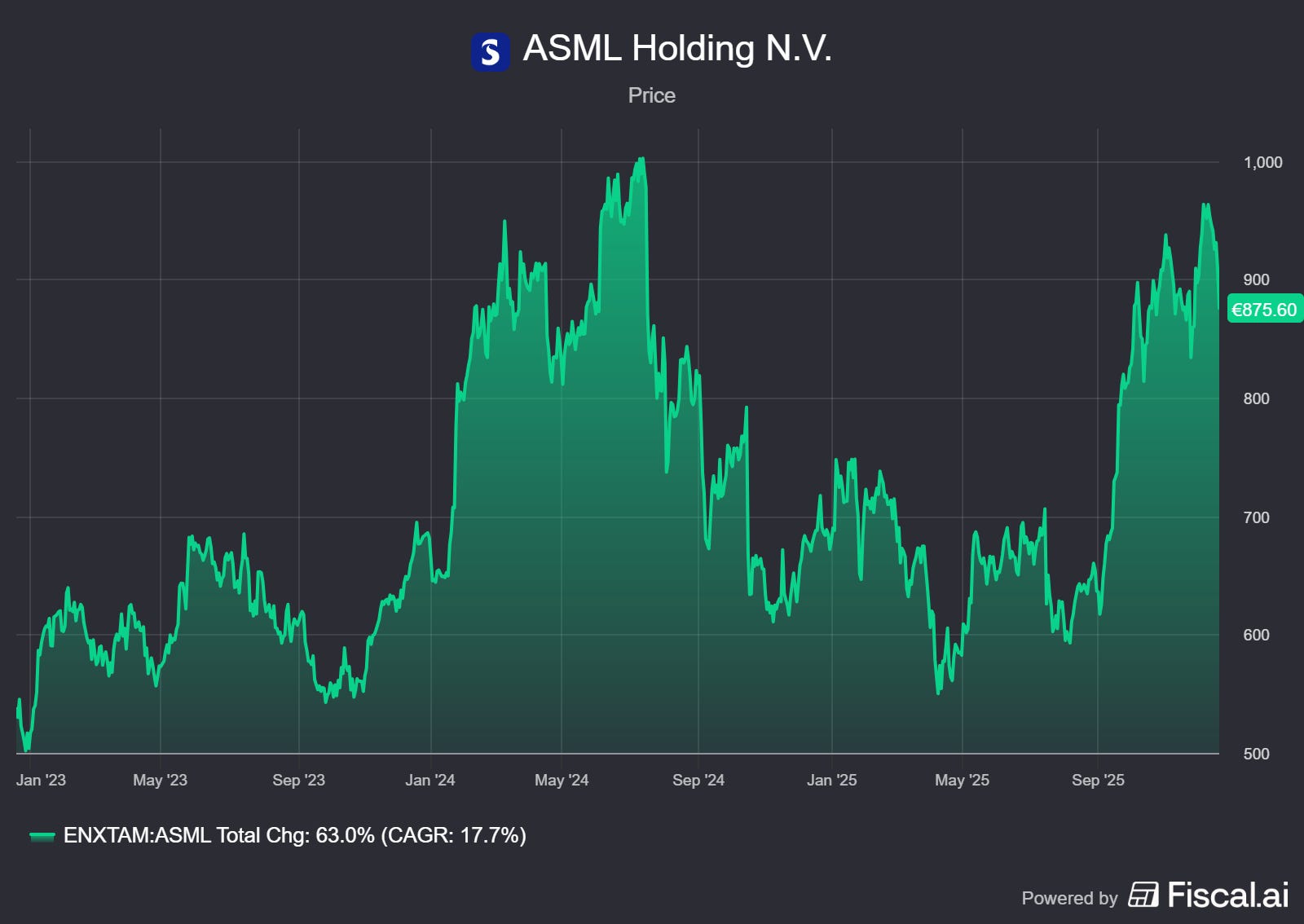
ASML - ASML 0.00%↑ - Once again funny enough, we are talking about one of the biggest companies in the world (the largest in Europe) and we have a 100% return from the lows in the very distant checks notes April 2025. There were customer capex delays among “weak order flow” along with geopolitical concerns, which affected their short term outlook and timing, but this is a monopolistic business (one of the best in the world IMO) and their moat showed no signs of deterioration and certainly not any pricing weakness. The secular tailwind for chips and semiconductor manufacturing has only been increasing, but sometimes the market overreacts and grows impatient (just like my toddler at home). This is the part where analysts (therefore investors) twist themselves in a pretzel and tweak their models and forecasts, and the market reaction subsequently goes crazy. Timing is a difficult game, but if you can stick to a solid fundamental analysis process you will likely be fine in the end and can capitalize on short term dislocations.
#10 - Power of momentum - good and bad…
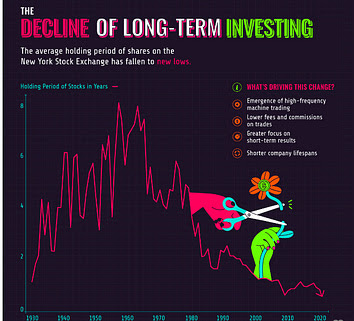
Momentum is a powerful force in today’s news driven financial markets. The market is statistically moving faster and faster due to technological advances, high-frequency trading (HFT), and now AI. This has been causing near-instantaneous price reactions to news, but this speed is concentrated in major stocks and moments like earnings, while overall market volatility also seems elevated due to economic factors like inflation shifts and geopolitical events, creating rapid bursts and periods of uncertainty. This is music to a long term investor’s ears as this creates the pockets of opportunity if we can distinguish between momentary weakness from strong long term fundamental picture (see ASML comments above). Currently, healthcare, payments, trucking, consumer brands, oil and gas, and many other segments are currently ‘out of favor’ as the AI trade is ruling everything. If you can look past negative sentiment and identify companies that are actively increasing their competitive position, generating strong cash flows, and have a secular tailwind behind it, out of favor companies and markets can be favorable ponds to fish. As retail investors, we have flexibility on our side as we are free to adjust our portfolio to that which corresponds to the best risk-adjusted weighted returns. We are also free to sit back and wait patiently for sentiment to change, which it so often does in an instant.
My learning point here has been to let the dust settle and do not try to fight against the market’s inertia. More times than not, I have acted overly quick rather than not quick enough. Negative sentiment can be falsely placed, but it can be a powerful market drug. See Point #1 in that most times you would typically be better suited to think deeply rather than act quickly and let prices consolidate a bit to form a nice juicy buying base. Use this knowledge to protect your downside, and best position yourself for strong returns on the upside. While the market environment is changing, human behavior is not and will never!
Market is dominated by short term traders > Who only care about the stock > Who cannot own stocks with negative momentum > Amplifying general downside risk > Creating an opportunity for long term investors > Thank you
“The market can remain irrational longer than you can remain solvent." - John Maynard Keynes
Conclusion
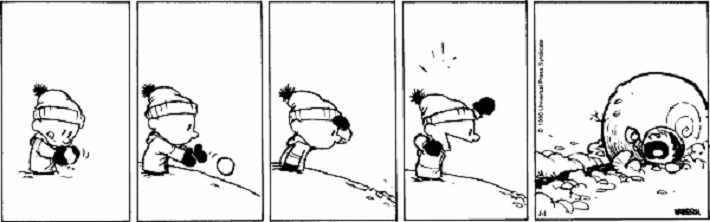
Compounding is like a snowball slowly rolling down the mountain. My portfolio is continually growing (buoyed by the latest bull market) and while the insights I write about here may seem insignificant in the grand scheme of things, I can honestly say that I am learning valuable information (albeit paying my tuition to the market at times). As long as I am learning, I am growing, and I am confident that my investing journey is only just beginning. Investing is an incredible intellectual pursuit that will inevitably be filled with many highs and lows, but if you are learning and growing, and can stay rational in this crazy world, then you are truly winning in life.
Charlie Munger emphasized continuous learning as key to rising in life, famously saying, “Those who keep learning will keep rising in life,” and adding, “Nothing has served me better in my long life than continuous learning”, highlighting that people become a little wiser each day by being lifelong learning machines, not necessarily the smartest, but always gaining knowledge to stay ahead. The biggest threat to my investing is honestly myself. Whether not having the disciplined behavior, stoic psychology, or whether I flat out decide to give up one day. The choice alone is mine, just as it is yours, to enjoy the pursuit and know your goal. Block out the noise and just keep learning.
“I constantly see people rise in life who are not the smartest, sometimes not even the most diligent, but they are learning machines. They go to bed every night a little wiser than they were when they got up”. - Charlie Munger
Learn, grow, rise! Have a wonderful 2026!
Poor Charlie